

Women's health doesn't have a funding problem, but an infrastructure problem
Not that many years ago, I thought women’s health was somebody else’s issue and somebody else’s business.
My business was investment banking, asset management, insurance, and risk. And what a ride that was. I've concluded that if one survived international investment banking in the 80s / 90s, one would probably survive anything. And would definitely have the best stories.

Petter Berge
Founder & CEO
The Big C
Then cancer entered our lives.
The love of my life, also my business partner, was diagnosed with late-stage breast cancer. The treatment we had available in our native Norway, for free, from a fantastic public health service and from a superstar cancer surgeon, saved her life. That is cause for eternal gratefulness, for the system and to the individuals who made it all possible.
But what came afterwards opened my eyes to something just as substantial.
The hidden burdens
The cancer treatment left her with severe lymphedema. There was no suitable treatment available locally, and this was clearly not considered a high priority issue to fix. In the medical world, the highest prestige is fixing the things that kill men (and to some extent women), not sorting women's side effects from illness survival. Which is possibly how it should be, if we're considering just one item on a list of endless priorities.
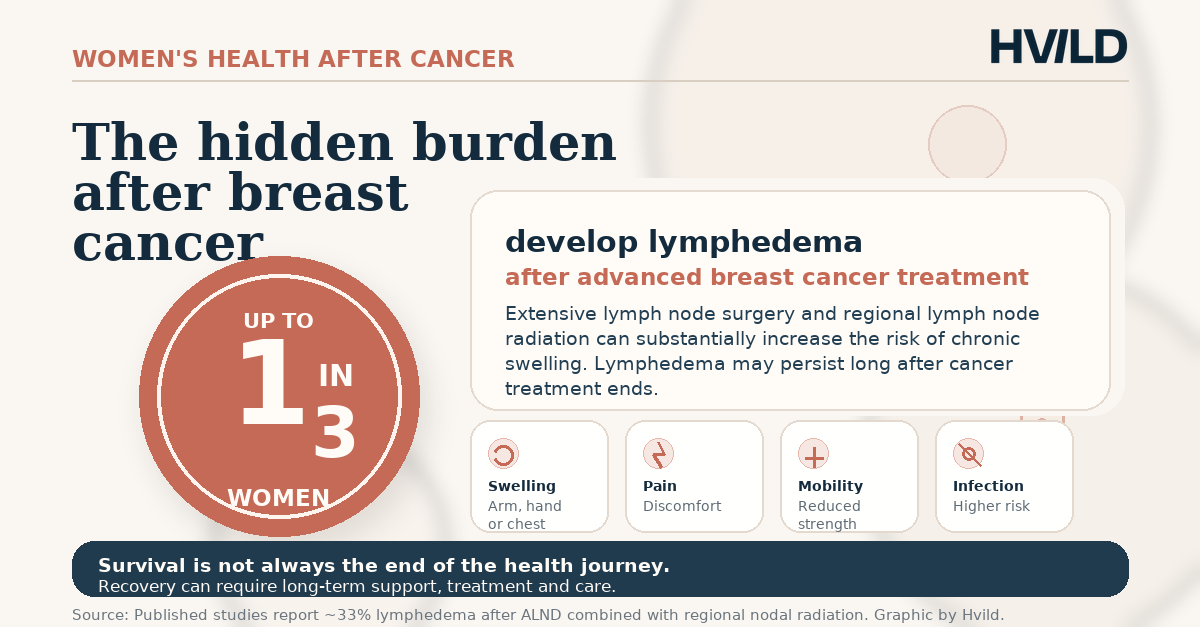
But rather than resigning to that state of affairs, we spent months searching the world for solutions ourselves. Eventually we found a brilliant professor in roughly the same time zone as us, and who could have been cast by Hollywood as the eccentric genius doing stuff his colleagues disapproved of. He could fix. An extreme solution, but with a great track record - albeit with a matching price tag
We secured access, and as the statute of limitations has probably passed, I can admit that there is a possibility that not all was done 100% by the book. Our new professor friend was up to anything that poked a finger in the eye of non-believers. We were fortunate enough to be able to pay ourselves, there was no insurance cover for these things.
A very complicated procedure, but it worked. The lymphedema did not go away, it is chronic, but now in a form that is manageable. It no longer threatens to trigger sepsis on every journey with an airplane. So the problem was solvable, if not curable, but the system didn't do it. We did it. And hey, we even got some of the money back, well - eventually.
Then came the next surprise. Chemotherapy had put her into immediate menopause. That is a normal consequence, not many ifs or buts about it, chemo will most likely do just that.
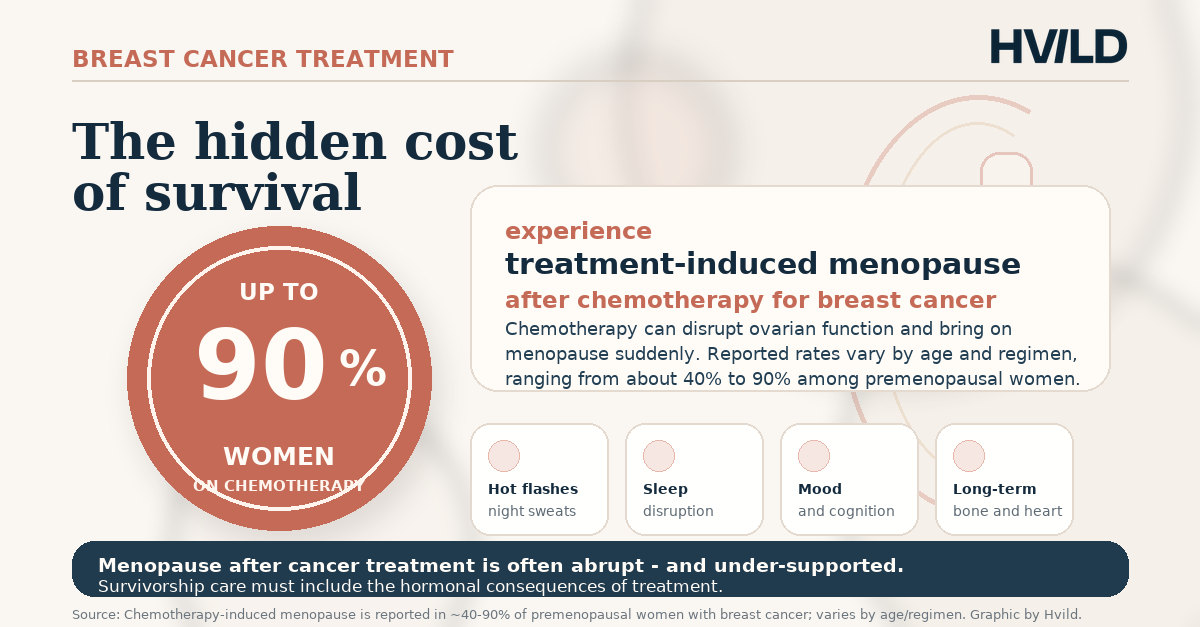
But nobody had bothered to explain that either. Nobody had explained the probable symptoms. Nobody had told her how this would most likely be a new and very low normal, and with life changing consequences. In fact, the word "menopause" was never mentioned.
For years she struggled with pretty much the full range of severe menopause symptoms, without a diagnosis. That list is long, there are more than 100 menopause-linked recognized symptoms. GPs, bless their little overworked hearts, mainly suggested new versions of drugs to reduce individual symptoms. Her quality of life fell, week by week and year by year. Rebuilding the old professional life as a high powered finance lady seemed impossible.
Almost a decade passed before a chance encounter with a talented gynaecologist finally connected the dots. HRT reconnected light and colours, and almost overnight gave back the old quality of life. She’s totally back back in business. With me, even, which might be a better deal for me than for her.
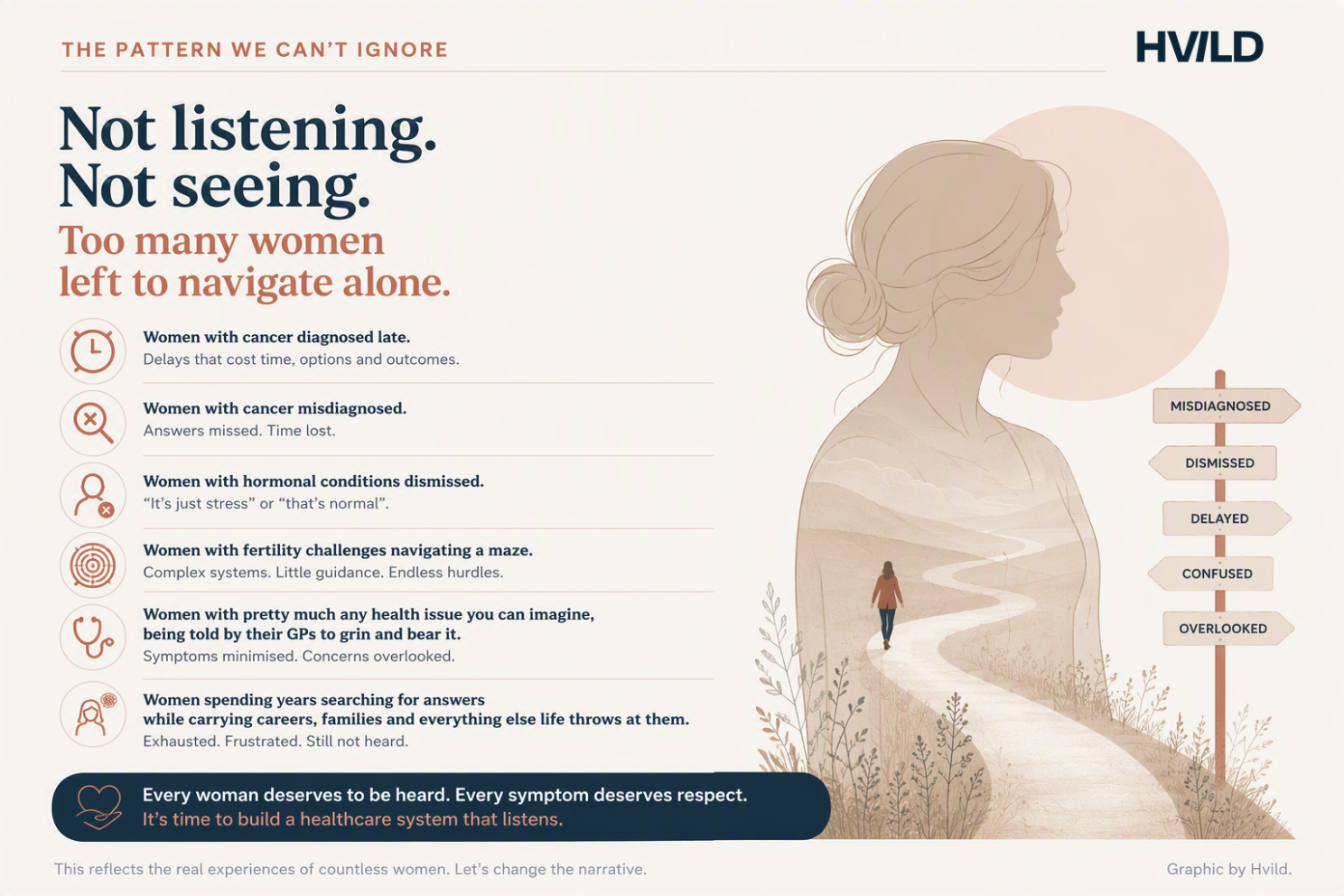
But by this time, I was really paying attention, and I tend to zone out completely when that happens. Once I had started paying attention, I saw the same pattern everywhere.
The pattern we can't ignore
But I also saw that the sad list in the graphic above was not because people don't care. Most people do care, and in the medical professions – people care more than anybody.
The core problem is systemic. It is essentially that nobody owns the whole journey, except the patient.
A woman experiences one life. But the system sees cancer. It sees menopause, infertility, mental health issues, insurance, workplace support, sick leave, specialists. There is no end to the list. The World Health Organization (WHO), recognizes over 2 million distinct medical descriptions, diagnostics and combinations, that can apply to all of us. 2 million.
The system sees one problem, out of those 2 million, at a time. Nobody connects the dots. And that, as I have increasingly come to believe, is the real women's health gap.
The real gap is not a lack of clinics or doctors. It is not a lack of innovation – 5 000 new medical research articles are published every day. That is one per 16 seconds. Probably not all totally brilliant, but still.
It is not even a lack of funding, at least not at the accumulated level. According to the WHO, the world spends $10,6 trillion annually on health care. That is about half the GDP of the European Union, and more than the GDP of any other country in the world than the USA and China. Admittedly, that spend is not equally shared between countries and regions, and it is definitely not equally shared between the genders. Less than 6% of private health R&D spending is on women’s health. But that is not the real problem. There is massive health funding out there, at least in total.
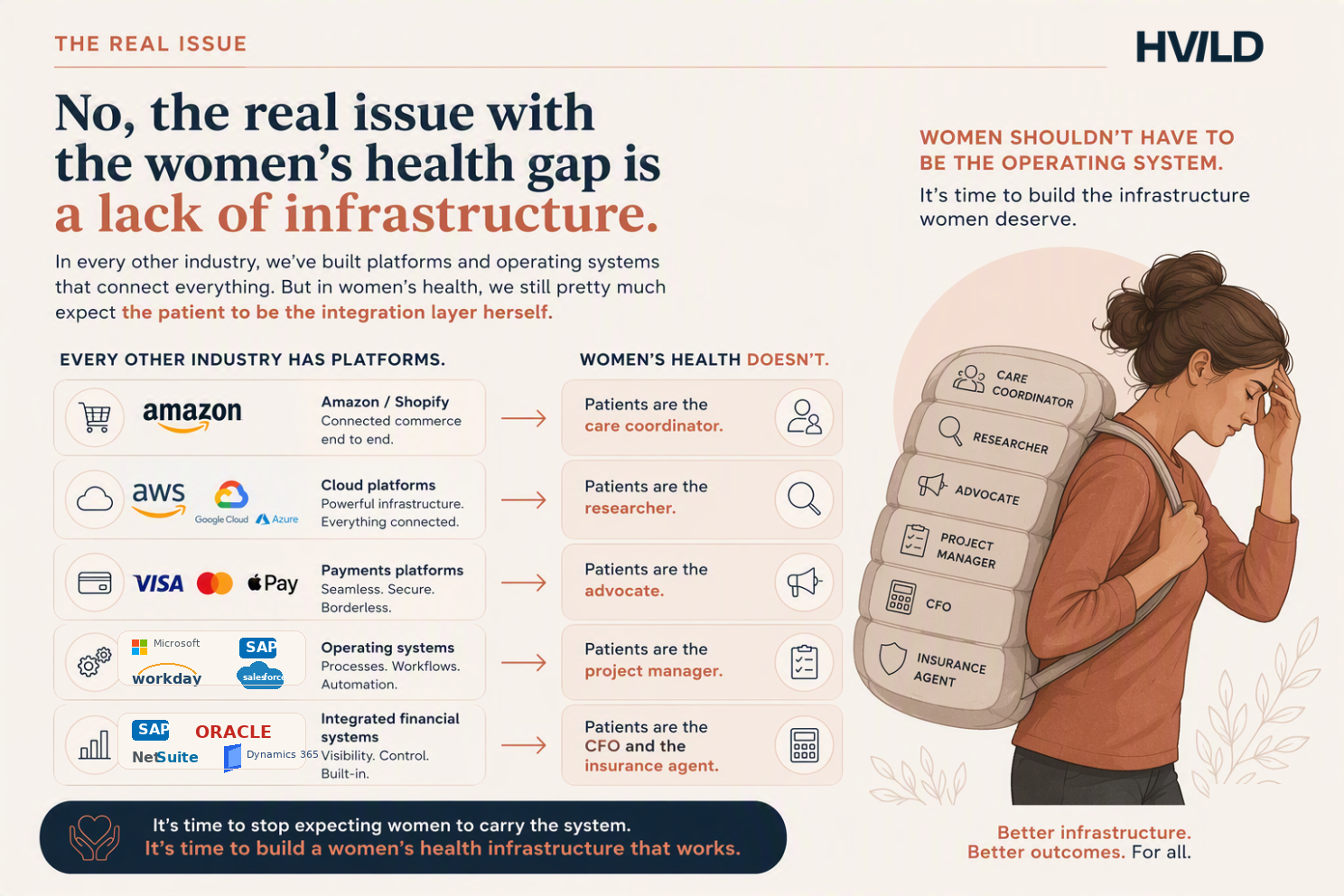
No, the real issue with the women’s health gap is a lack of infrastructure.
In every other industry, we’ve built platforms and operating systems that connect everything. Think Amazon or Shopify for the retail industry – remember bookstores anybody? In cloud computing, platform is now pretty much the only game in town (AWS (yes, them again, but credit where credit is due, Jeff Bezos ), Google Cloud, Azure). And never mind payments, the basis for fintech. Remember when passing a European border meant a stop and a queue at an exchange booth, to change cash into francs, lira, pesetas etc, every time? Now we don't even have to brake at EU border crossings, and we have Visa, Mastercard and Apple Pay to settle the bills, wherever they may arise and regardless of currency.
But in women's health, we're still pretty much expecting the patient to be the integration layer herself.
That is not only backwards, it is just plainly wrong.
Nobody recovering from cancer should have to find critical treatment themselves through obscure searches on Google, or by depending upon the husband from hell (as I was described by a public sector claims handler that finally accepted to partially pay up). Even though AI has made information access infinitely better.
Nobody should have to spend a decade suffering through an undiagnosed and eminently treatable menopause.
Nobody should have to rely on luck to find answers. Even if sometimes one is lucky enough to be seated next to the doctor with the cure, and who also becomes the Chief Medical Advisor that leads to a Hvild startup.
The more I learn, the less I believe women's health is a healthcare problem alone.
It's an infrastructure problem.
And the biggest health and business opportunity over the next decade is not building another point solution. It is building the operating system and platform that finally connects them all.
That is what why have gone all in, with our co-founding partners GLASTAD and Christian Moxon, creating just that new layer, at Hvild.
That is why we have become an award winning licensed insurer for all of the EU / EEA.
That is why we have developed women-only health insurance covers, that fill some of the blanks for women.
That is why we have developed an interactive and AI-driven digital platform for women's occupational health.
That is why we offer advisory support, training and certification to employers wanting to do the right thing for their female employees.
Read more about us here or try out our new HvildHub digital health platform for employers, employees and families here.
Get in touch with Petter here if you're interested in participating in the women's health revolution, as an investor, provider or partner.
